Frequently asked questions
Asbestos questions, answered
Straight, practical answers from the JP Franklin asbestos team – based on WorkSafe New Zealand guidance and more than a decade of asbestos work in Auckland.
Do I have asbestos?
Do I have asbestos in my roof?
If your roof is Super Six (corrugated cement), Decramastic or pressed-metal tile, or fibre-cement shingle, and it was installed before the mid-1980s, there is a good chance it contains asbestos. A laboratory test of a small sample will confirm it.
How can I tell if my roof contains asbestos?
You can’t tell just by looking – asbestos cement looks identical to non-asbestos fibre cement. Have a trained person take a sample and send it to a laboratory. Don’t break off a piece yourself.
Does my 1970s Auckland house have asbestos?
It’s likely. WorkSafe advises that any home built before 1 January 2000 may contain asbestos. In 1950s–90s Auckland homes we commonly find it in roofing, cladding, soffits, textured ceilings, vinyl flooring and wet-area linings.
Where is asbestos usually found in a house?
Common places include roofing (Super Six, Decramastic tiles), cladding and soffits, textured “popcorn” ceilings, vinyl flooring, bathroom and laundry linings, hot-water-cupboard linings, fences, water tanks, downpipes and old electrical meter boards.
Can I take a sample myself?
We don’t recommend it. Sampling disturbs the material, so it should be done by someone trained to wet the area, wear the right respiratory protection and seal the sample point afterwards.
Health & safety
Is asbestos dangerous if it isn’t disturbed?
Intact, non-friable asbestos (such as asbestos cement in good condition) that isn’t disturbed is generally low risk. The danger comes when it deteriorates or is drilled, cut, sanded, broken or water-blasted, releasing fibres that can be inhaled.
What should I do if I find damaged asbestos?
Don’t disturb it further. Keep people and pets away, close doors and windows to the area, don’t sweep or vacuum debris, and call us for advice and an assessment.
What diseases does asbestos cause?
Breathing in asbestos fibres can cause mesothelioma, lung cancer, asbestosis and pleural disease. These diseases usually appear 10 to 50 years after exposure. WorkSafe estimates around 170 New Zealanders die each year from asbestos-related disease.
Can I water-blast or paint my asbestos roof?
Never water-blast or dry-sand an asbestos roof – it releases fibres and contaminates your section. A sound asbestos roof can be sealed and painted using asbestos-safe preparation and fibre-sealing coatings applied by professionals.
Do I need to leave my house during asbestos removal?
For most exterior jobs such as roof or cladding removal you can stay home with windows and doors closed and the work area off limits. For interior or friable removals you may need to stay elsewhere until clearance is given – we’ll explain in your removal plan.
Removal & the law
Can I remove asbestos myself in New Zealand?
Up to 10 m² of non-friable asbestos can be removed without a licence by a competent person, but you must control dust and dispose of it correctly. Any friable asbestos, and more than 10 m² of non-friable asbestos in a job, must be removed by a WorkSafe-licensed removalist.
What is the difference between Class A and Class B asbestos removal?
A Class A licence covers any type or quantity of asbestos, including friable (crumbly or powdery) asbestos. A Class B licence covers more than 10 m² of non-friable (bonded) asbestos such as asbestos cement sheeting.
How long does asbestos removal take?
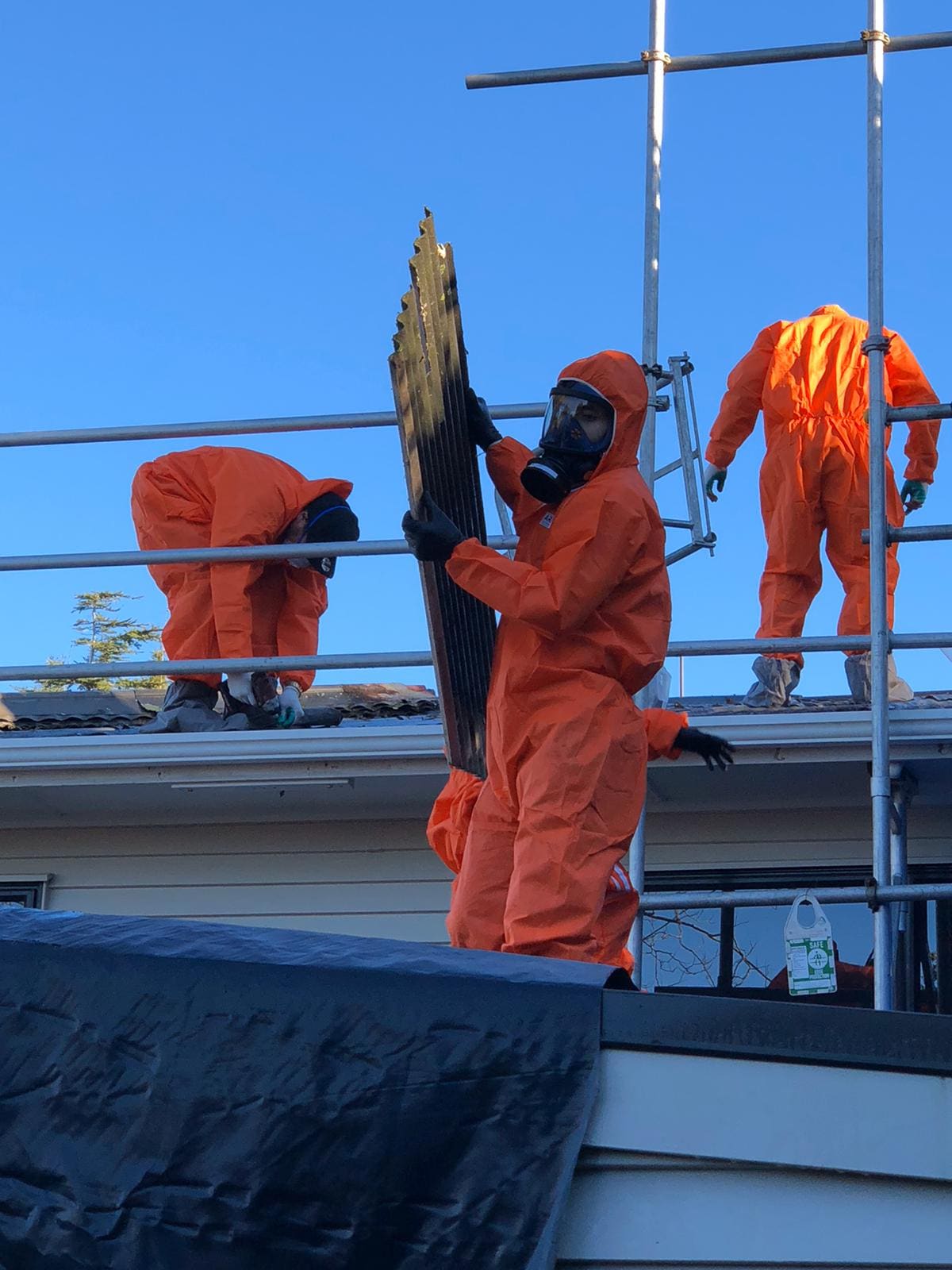
A garage roof is often done in a day. A typical house roof takes one to three days to remove, or one to two weeks including a new roof. Large commercial projects are staged over several weeks.
What happens to asbestos after it is removed?
It is wetted, double-wrapped in heavy-duty plastic, labelled, transported in a covered vehicle and buried at a landfill licensed to accept asbestos. You receive the disposal dockets.
Do I need a clearance certificate?
After Class A (friable) removal, an independent licensed asbestos assessor must carry out a clearance inspection, including air monitoring, and issue a clearance certificate. After Class B removal a clearance inspection is still required, carried out by an independent competent person.
Asbestos roofs
Can an asbestos roof be repaired?
Yes, in many cases. Damaged Decramastic tiles or Super Six sheets can be replaced using asbestos-safe methods. If the roof is brittle and failing in several places, replacement is usually better value.
Should I remove or encapsulate my asbestos roof?
Encapsulation suits roofs that are still sound and will not be disturbed – but WorkSafe’s code of practice treats it as a temporary measure that needs regular re-inspection. If the roof is cracked, leaking or heavily weathered, removal and replacement is the long-term solution.
Can you replace the roof after asbestos removal?
Yes – that’s our speciality. JP Franklin removes the asbestos and installs a new long-run Colorsteel, metal-tile or asphalt-shingle roof with our own roofers. One company, one quote, one project.
Can you put a new roof over an asbestos roof?
Over-roofing leaves the asbestos in place, adds weight and can complicate building consent and future work. In most cases we recommend removing the asbestos roof and installing the new roof on properly prepared battens.
Can I install solar panels on an asbestos roof?
Drilling and walking on an asbestos roof disturbs it, so it isn’t recommended. Most homeowners replace the asbestos roof first – the new roof will then outlast the solar panels.
Costs & quotes
How much does asbestos removal cost?
Every property is different. Price depends on the area, type of asbestos, roof pitch and height, access, condition, the containment required, disposal, and whether you want a replacement roof or cladding. See our cost guide, or upload photos for a free estimate.
Do you provide free quotes?
Yes. We provide free site assessments and written quotes. Send us photos first and we can often give you an indicative estimate before visiting.
Can you tell if it’s asbestos from a photo?
A photo can tell us whether a material is likely to contain asbestos and what the next step should be, but only laboratory testing can confirm it. Photos also help us prepare an accurate estimate.
Do you offer finance?
JP Franklin has offered finance options on roofing projects. Ask us about current options when you request your quote.
Landlords, buyers & businesses
Can I buy a home with asbestos?
Yes. Many older homes contain some asbestos. Get a pre-purchase asbestos survey so you know where it is and what condition it’s in, then factor any future removal into your decision.
Do landlords have to deal with asbestos?
When work at a rental could expose workers or tenants to asbestos fibres, residential landlords must identify the asbestos and prepare an asbestos management plan for that work.
Do businesses need an asbestos management plan?
Yes. A business that manages or controls a workplace built before 1 January 2000 must identify asbestos (or assume it is present) and have an asbestos management plan under the Health and Safety at Work (Asbestos) Regulations 2016.
Do you work with property managers and insurers?
Yes. We work with property managers, body corporates, insurers, builders and developers, and provide reports and photos to support insurance claims.
Regulatory information is based on the Health and Safety at Work (Asbestos) Regulations 2016 and WorkSafe New Zealand asbestos guidance. It is general information – talk to us about your specific property.
One company · One quote · One project
Get your free asbestos assessment
Tell us what you’ve found – or send a few photos – and we’ll tell you what to do next. Free site assessments and written quotes across Auckland.